- Series
- | Authors
- | Book Release Calendar
- | Search |
- Genres
- | Newsletter
- Welcome to FictionDB, Guest
- | My Account
- | Help

Alliance-Union — by C.J. Cherryh
Alliance-Union Series in Order: 19 books
-
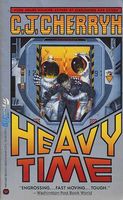 Heavy Time
Book - 1
Two asteroid miners find a dead, drifting ship--but its pilot, Paul Dekker, is alive, insane from shock, and screaming... screaming dues to a mystery that no one wants solved ... WHAT IS MAMA HIDING? Paul Dekker, a kid with a dream, wakes to a ...
-
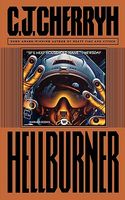 Hellburner
Book - 2
Forced to help jinxed pilot Paul Dekker, Ben Pollard becomes entangled unwittingly in a lethal deep space political mess. By the Hugo Award-winning author of
Heavy Time. and Cyteen. Reprint.... -
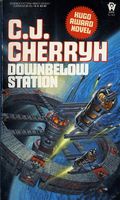 Downbelow Station
Book - 3
Pell's Star occupied the central spot in the coming conflict between Earth's tired stellar empire id the tough onslaught of its rebellious colonies. Whoever controlled Pell's Downbelow station held the key to Earth's defensive perimeter -- or the jum...
-
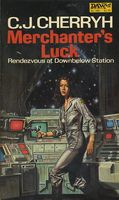 Merchanter's Luck
Book - 4
His name was Sandor and he was the owner and entire crew of a tramp star-freighter that flew the Union planets under false papers and fake names. Her name was Allison and she was a proud but junior member of the powerful family whose mighty starsh...
-
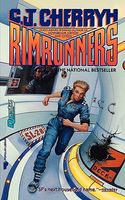 Rimrunners
Book - 5
Loki is a mercenary ship and bounty hunter. Bet Yeager is a killer elite Earth Company Marine whose side lost. Now she is forced to escape aboard Loki, surrounded by enemies and hunting her old comrades. And the fighting skills she must use to surviv...
-
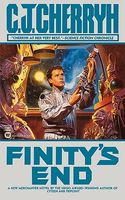 Finity's End
Book - 7
One of science fiction's most accomplished authors, C.J. Cherryh returns to the universe of her bestselling, Hugo Award-winning classics, Downbelow Station and Cyteen, with a thrilling, critically acclaimed new Merchanter novel of a starship-dwelling...
-

-
-
-
-
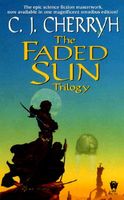 The Faded Sun: Kesrith
Book - 10
Experience an epic science fiction series offered in one omnibus edition. C.J. Cherryh's The Faded Sun Trilogy tells the story of the mri-tall, a secretive society bound by honour and strict discipline. This golden race for eons offered the unive...
-
The Faded Sun: Shon'Jir
Book - 11
Sten Duncan had saved the lives of the last two of humanity's deadliest enemies, during the takeover of their planet Kesrith. Sten therefore felt responsible for them and for their future -- if any. For though the two mri were brother and sister, th...
-
The Faded Sun: Kutath
Book - 12
This is the story of three people: Sten Duncan, a soldier of humanity; Niun, last warrior of the mri, humanity's enemies; Melein, priestess-queen of the final fallen mri stronghold. This is the story of two mighty species fighting for a galaxy: huma...
-
 Serpent's Reach
Book - 13
The constellation of Hydrus, known as the Serpent, is compact and obscure as seen from Earth's sky. Even in the great era of interstellar colonization it remained obscure. For it was under strict quarantine harboring an intelligent race, powerful, al...
-
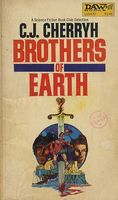 Brothers of Earth
Book - 14
SHE WAS PRIESTESS-RULER .. . in a world of humanoid aliens. Yet she was as human as he was, though their star-nations had been bitter enemies for two thousand years. "Welcome to my world, Kurt Morgan," she said. "We seem to be humanity's orphans ...
-
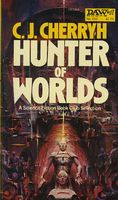 Hunter of Worlds
Book - 15
The iduve were the most advanced spacefaring race in the galaxy. They travelled where they pleased in giant city-sized vessels, engrossed with their own affairs. The iduve were humanoids--with a difference: they were predators incapable of human emot...
-
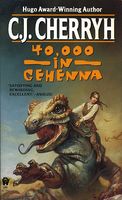 Forty Thousand in Gehenna
"Set in the same future as #f r Inning Downbelow Station, but fully self-contain , i5`is a story on the classic theme of human underestimation of the alien. The 40,000 colonists on Gehenna are abandoned for political reasons. When the re-supply ships...
-

Series Premise
The core premise of the series is an epic future history of humanity’s expansion beyond Earth. It begins with the Earth Company’s early colonization efforts, which fracture under distance, economics, and ambition. This leads to the devastating Company Wars, a prolonged conflict between Earth’s corporate fleet and the breakaway Union—a genetically engineered, authoritarian society centered on the planet Cyteen, reliant on cloned “azi†laborers and advanced psychological conditioning. Opposing both is the loose confederation of independent merchanters (family-run trading ships) and space stations that eventually forms the Merchanter Alliance. The stories examine the war’s brutal toll, its aftermath, and the fragile new order that emerges, where trade, politics, cloning ethics, stationer-merchanter tensions, and lingering militarism shape daily existence. Narratives range from large-scale fleet battles and station sieges to intimate character-driven tales of loyalty, betrayal, and adaptation in a galaxy defined by vast distances and competing ideologies.
Alliance-Union Series Reading Order
🟡 Mostly Standalone · Start Anywhere
Mostly standalone stories with recurring characters in a shared setting.
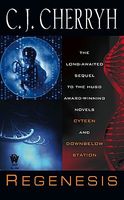
The reading order of the Alliance-Union series is notably flexible, reflecting Cherryh’s own advice that most books can be approached “just like real historyâ€â€”in any sequence—without losing core understanding. The majority of the novels function as standalone or loosely interconnected stories set at different points across the timeline, allowing readers to dip in based on interest (e.g., merchanter-focused tales or Union-side politics). However, two tight pairs benefit from internal order: Heavy Time followed by Hellburner (prequels involving Company Fleet pilots and early war tensions), and Cyteen followed by its direct sequel Regenesis (a deep dive into Union cloning and power structures). Downbelow Station, the Hugo-winning cornerstone depicting the war’s climax at Pell Station, serves as an excellent entry point for many. Chronological reading enhances appreciation of historical progression and recurring societal shifts, but publication or thematic order works equally well for most readers. The flexibility is a deliberate strength, mirroring the fragmented, multi-perspective nature of the universe itself.
Explanation of reading order types
Alliance-Union Series Characters
No single protagonist dominates the entire universe, reflecting its mosaic nature. Key recurring or emblematic figures include Signy Mallory, the fierce, pragmatic captain of the carrier Norway, who defects during the war and embodies the moral ambiguities of command. Ariane Emory, the brilliant, ruthless Union administrator and scientist at Reseune on Cyteen, whose cloning legacy and political machinations drive major Union-side stories. Merchanter captains and crews, such as those in family ships like the Pride of Chanur (though Chanur is a related but distinct thread), highlight trade and independence. Station leaders, Earth Company executives, and azi characters provide diverse perspectives on power and conditioning. Recurring elements—such as the hisa, fleet remnants, or political operatives—tie stories together without requiring linear reading, while families and crews often serve as emotional cores.
Setting of the Alliance-Union Series
The setting is one of the most richly realized in science fiction: a future where humanity has spread across stars via slower-than-light travel and massive stations, creating distinct cultures. Earth remains a distant, increasingly irrelevant authority. Union dominates with its planet Cyteen, azi cloning facilities at Reseune, and authoritarian efficiency. The Alliance emerges from merchanter families and neutral stations like Pell (Downbelow Station), where the native hisa (gentle, enigmatic aliens) add complexity. Space itself feels vast and unforgiving—long hauls between stations breed isolation, while the Company Fleet’s carriers and merchanter ships represent mobile power centers. The atmosphere is gritty and lived-in: cramped station corridors, zero-g maneuvers, political meetings in sterile offices, and the constant pressure of resource scarcity or military threat. Later stories expand into post-war reconstruction, with stations and ships as microcosms of society.
Tone & Themes of the Alliance-Union Series
Tonally, the books are dense, cerebral, and often claustrophobic, with a cool, observational style that immerses readers in bureaucratic minutiae, strategic maneuvering, and psychological tension. Cherryh’s prose is precise and layered, favoring internal monologues, cultural detail, and slow-building suspense over explosive action. The mood is frequently somber and realistic—war is grueling and morally ambiguous, politics is labyrinthine, and victory carries heavy costs—yet moments of quiet humanity, loyalty, and hard-won understanding provide emotional anchors. Humor is subtle and ironic rather than light-hearted. Thematically, the series probes the nature of power and its corruption, the ethics of genetic engineering and mind control, the clash between individualism (merchanters) and collectivism (Union), the long-term consequences of colonialism and war, identity in a post-human or engineered context, and the fragile bonds that hold societies together amid vast distances and ideological divides. Cherryh excels at portraying how systems shape people—and how resilient individuals can subtly reshape systems—while questioning loyalty, freedom, and what it means to be “human†in an expanding, fractured galaxy.
In the end, the Alliance-Union series by C.J. Cherryh stands as a towering achievement in science fiction—a meticulously constructed future history that feels as real and contradictory as our own past. Cherryh invites readers into a galaxy where vast distances breed both isolation and unexpected connection, where empires rise and fracture, and where ordinary (or engineered) individuals navigate moral gray zones with quiet determination. These stories challenge assumptions about loyalty, progress, and humanity while delivering intellectual depth and emotional resonance. For readers who relish thoughtful space opera with sociological insight, complex characters, and a universe that rewards repeated visits, Alliance-Union offers an enduring voyage—one where the stars are cold, the politics are intricate, and the human (or azi) spirit proves remarkably resilient. Step aboard a merchanter ship or into a Union lab, and discover why Cherryh’s vision of humanity’s future remains as compelling and relevant as ever.
Books in this series fall into the following genres
Genres
Sub-Genres
Themes
Frequently Asked Questions (FAQ)
Top Series in Space Opera